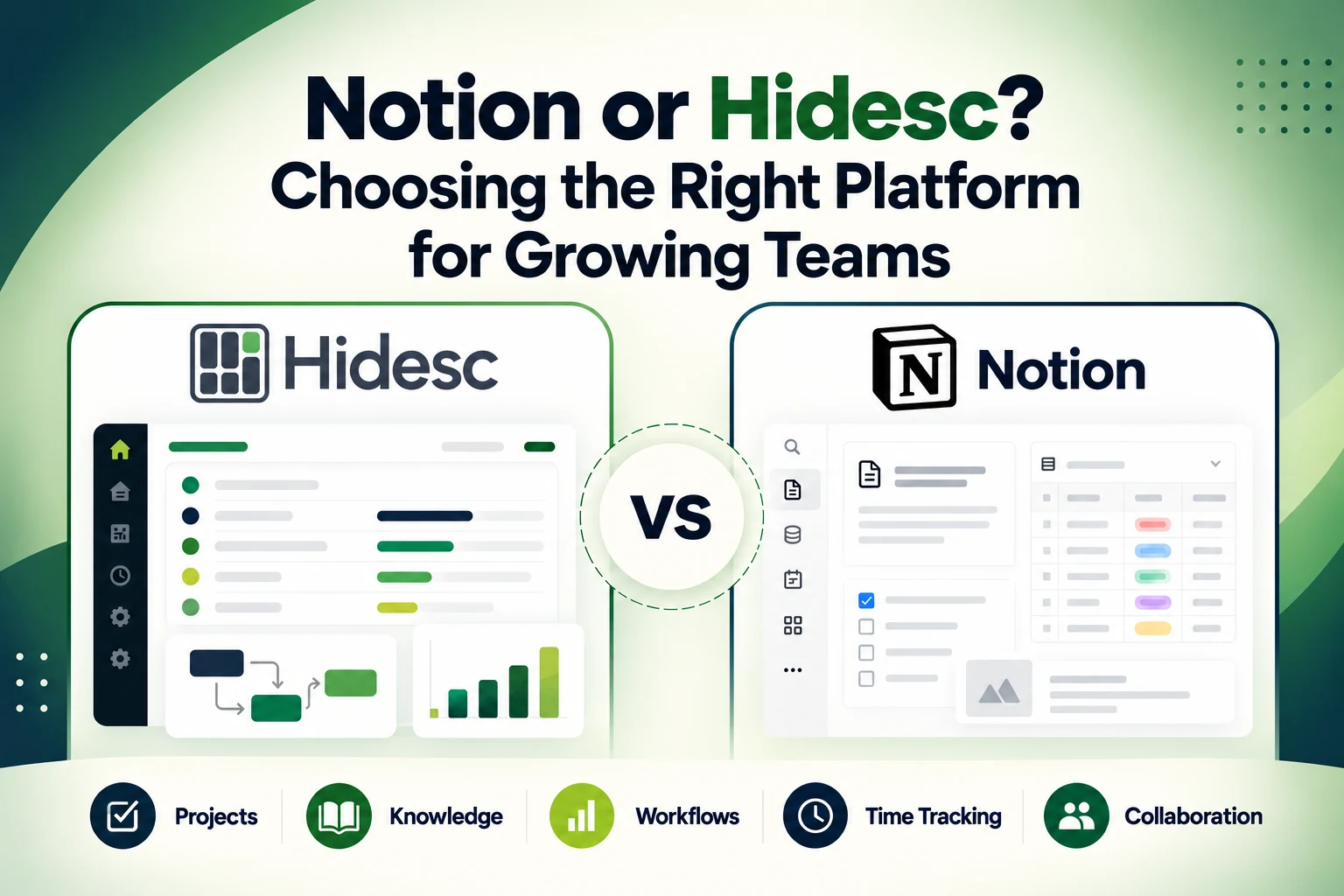
Compare Notion vs Hidesc for growing businesses across project management, workflow automation, team collaboration, knowledge management, organizational visibility, pricing and total cost of ownership.
As teams grow, they often require more than basic task management software. Projects get more complex, knowledge within the company grows, and workflows need to be more closely coordinated. The right platform depends on how the business plans, documents, communicates and controls work.
Businesses may wish to take a look at Notion vs Hidesc etc. Notion is an all-in-one workspace for notes, tasks, wikis and databases. Hidesc is an all-in-one work management platform that combines task management, workflow automation, team collaboration, time tracking, and organizational visibility.
This comparison looks at the features, pricing, pros and cons of both platforms to help growing businesses make an informed choice.
Notion vs Hidesc: At a Glance
| Category | Notion | Hidesc |
|---|---|---|
| Project Management | Yes | Yes |
| Task Management | Yes | Yes |
| Workflow Automation | Yes | Yes |
| Team Collaboration | Yes | Yes |
| Documents and Wikis | Core strength | Included |
| Native Time Tracking | Limited | Built in |
| Multi-Level Approvals | Custom setup | Built in |
| Organizational Charts | Custom setup | Built in |
| Reporting and Dashboards | Yes | Yes |
| Primary Fit | Knowledge and flexible workspaces | Projects and business operations |
What Is Notion?
With Notion, teams get a connected workspace to organize documents, company knowledge, projects, tasks and databases. Its building blocks are flexible enough that companies can create custom systems for project tracking, wikis, meeting notes, goals, and internal processes.
Main features of Notion
- Documents, notes, company wikis
- Linked information and custom-built databases
- Calendar, Table, Board, and Timeline views
- Project and Task Follow-Up
- Templates - Forms - Charts - Database automation
- Integrations, Search and Collaboration Features
Limits of Notion
- Setups and customizations can be time-consuming
- Tailored configuration for formal approval workflows
- No native task timer dedicated
- Departments may have different workspace structures
- May have separate tools for timesheets, invoices and controlled operations. -
What Is Hidesc?
Hidesc is a platform for teams, projects, workflows and organizations to manage their work. It puts these functions into one common working space.
Unlike flexible workspace tools where teams have to build lots of systems themselves, Hidesc comes with structured capabilities for task execution, workflow automation, approvals, time tracking, OKRs, documents, team communication and organizational visibility.
Key Hidesc Features
- Project and task management
- Workflow automation and business process management
- Native time tracking and timesheets
- Multi-level approval workflows
- OKR and goal management
- Organizational charts and employee visibility
- Collaboration tools, dashboards, and progress tracking
Hidesc Advantages
- Connected business management features
- Built-in time tracking and approval workflows
- Organizational chart and employee visibility
- Department-level coordination
- Fewer separate systems for growing teams
Detailed Feature Comparison
Project Management
Notion includes project databases that you can customize and display in table, board, calendar, or timeline view. Teams can link tasks to project documents, meeting notes, goals and supporting knowledge.
Hidesc is a specialist in project planning, assignment, recurring tasks, progress monitoring, team coordination, templates and workflow visibility. Projects can be directly linked to approvals, time records, permissions and organizational structures.
Key Differences : Both platforms allow for project planning. Notion is about flexible databases and connected documents. Hidesc connects projects with structured business processes.
Task Management
Notion has custom task properties, statuses, priorities, assignees, due dates, sub-tasks, dependencies and filtered views. Tasks can also serve as detailed pages with notes, files, checklists, and related information.
Hidesc supports assignments, deadlines, recurring work, progress tracking, workflow integration, team execution, department visibility, permissions and reusable project templates.
Key Differences : Notion’s tasks are flexible and document-centric. Hidesc offers more structured task controls for repeatable operational work.
Documents and Knowledge
Notion builds on collaborative documents and company knowledge. Teams can create wikis, meeting notes, process guides, project briefs and linked databases in a single flexible workspace.
Hidesc offers document storage, categorization, version history, verification, control of access, expiry reminders, and links between documents, tasks, and projects.
Key Differences : Notion is better for collaborative writing and knowledge bases Hidesc is more into controlled business documents and operational records.
Workflow Automation
Notion has database automations, buttons, templates, formulas, notifications and integrations. Teams can create their own workflows with triggers and actions, and the structure of their database.
Hidesc brings automation to approval workflows, departmental processes, task routing, reminders, recurring work, escalation rules and overall business workflow automation.
Key Differences : Notion's flexible database automation. Hidesc automates approvals and cross-departmental business processes.
Time Tracking and Approvals
Notion can store dates, calculate time passed with formulas, and connect to external time tracking services. You can set up approval processes with status fields, reviewer properties, buttons and automations.
Hidesc allows task timers, manual time logs, timesheets, billable flags, time-entry approvals and multi-stage approval workflows. These enablement are directly connected with tasks, projects, documents and business processes.
Key Differences : Notion needs to be configured or augmented with external tools to create dedicated time and approval workflows. These capabilities are built-in operational features of Hidesc.
Team Collaboration
Notion has comments, mentions, shared pages, teamspaces, collaborative docs, and guest access. Communication is linked to pages, projects and database records.
Hidesc is task comments, team chat, department coordination, shared work spaces, organizational visibility, workflow based communication.
Key Differences : Notion facilitates collaboration around documents and knowledge. Hidesc also connects communication with departments, tracked work and reporting structures.
Reporting and Analytics
Notion provides custom dashboards with database views, filters, relations, rollups, formulas, and charts. Teams can create reports based on stored projects, goals, content, and more.
Hidesc offers project dashboards, team performance reporting, workload visibility, deadline tracking, workflow insights and department level visibility through an analytics dashboard.
Key Differences : Notion has flexible, database-driven reporting. Hidesc is designed for operational, project, work flow and organizational reporting.
Why Growing Businesses Need More Than a Flexible Workspace
There are many businesses that start with documents, task lists and simple project boards. As they grow, new challenges emerge, such as managing multiple departments, tracking reporting relationships, coordinating cross-functional teams, controlling access, recording work hours, and standardizing approval processes.
At this point, businesses want more than just flexible pages or task tracking. What they need is a platform that links people, projects, knowledge and processes. Notion is more flexible in terms of building a connected knowledge workspace. Hidesc has more structured tools for business operations, workflow automation, permissions and visibility at the department level.
Notion vs Hidesc: Ideal Use Cases
Choose Notion If
- You primarily need documents, wikis, and flexible databases.
- Your team wants to build customized project and knowledge systems.
- You need rich pages for notes, research, briefs, and internal guides.
- You already use separate time-tracking, invoicing, or approval tools.
- Your team values AI-assisted search across company knowledge.
Choose Hidesc If
- You want connected project and business management functionality.
- You need native time tracking, timesheets, and billable-hour controls.
- You manage multi-level approval workflows.
- You need org charts and employee transparency.
- You’re managing more than one department or cross-functional team.
- You require business process workflow automation.
Pricing and Total Cost of Ownership
Pricing is important, but growing businesses should also consider total cost of ownership. A flexible workspace may require extra software for time tracking, timesheets, formal approvals, invoicing, organizational charts, employee visibility, and business process automation.
| Pricing Factor | Notion | Hidesc |
|---|---|---|
| Free Access | Free plan available | One-month free trial |
| Entry Paid Plan | Plus: $10 per member/month annually | Starter: $2.49 per user/month |
| Higher Team Plan | Business: $20 per member/month annually | Advanced: $4.99 per user/month |
| Workflow Automation | Included; limits depend on plan | Included |
| Native Time Tracking | Not a core feature | Included |
| Multi-Level Approvals | Custom setup | Included |
| Organizational Charts | Custom setup | Included |
| Additional Software Required | Depends on workflow | Usually less for operational needs |
Notion can reduce the need for separate document, wiki, and lightweight project tools. Hidesc brings several operational functions into one platform to reduce software fragmentation. The better value depends on which external tools each platform can replace for the business.
Final Verdict
Notion and Hidesc serve different business needs. Notion may suit teams that prioritize collaborative documents, company knowledge, flexible databases, and customizable project systems.
Hidesc may suit teams that want projects, workflow automation, time tracking, approvals, organizational structures, and department visibility in one platform. Compare current features, integrations, and pricing against actual requirements before choosing.
Frequently Asked Questions
Is Hidesc a good replacement for Notion?
Yes. Hidesc can be a Notion alternative for businesses that need project management, workflow automation, time tracking, approvals, organizational management and team collaboration in one platform..
What is the biggest difference between Notion and Hidesc?
Notion is about flexible documents, wikis, databases, and customizable workspaces. Hidesc bundles project management, structured workflows, time tracking, approvals, organization visibility and business process automation.
Does Notion have project management features?
Yes. Notion has projects, tasks, owners, deadlines, dependencies, database views, timelines, templates, automations.
Does Hidesc support workflow automation?
Yes. Hidesc offers workflow automation for task routing, approvals, reminders, recurring processes, escalations, and cross-team operations.
Does Notion include native time tracking?
Notion can keep dates and do elapsed time calculations, but it does not have a dedicated native task timer like Hidesc’s timer and timesheet system. Teams may require external integration or configuration.
Which platform is better for knowledge management?
Notion is better for company wikis, collaborative documents, meeting notes, linked knowledge generally. Hidesc may be more suitable for controlled documents requiring verification, permissions, access history, and lifecycle management.
Which platform is better for growing businesses?
The better fit depends on the requirements. Notion may suit businesses that need a flexible knowledge and project workspace. Hidesc may suit businesses that need organizational visibility, time tracking, department management, formal approvals, and business process automation.
Why Are Businesses Choosing All-in-One Work Management Platforms?
All-in-one platforms can reduce software fragmentation, improve collaboration, centralize business information, and simplify operations. Businesses should still evaluate usability, integrations, implementation effort, and the exact features included in each plan.
Related Hidesc Resources
Compare work execution with task management software, automate processes through workflow automation, manage records with document management, and visualize company structure with the organogram maker.